
Defining Paint Thickening and In-Can Stability
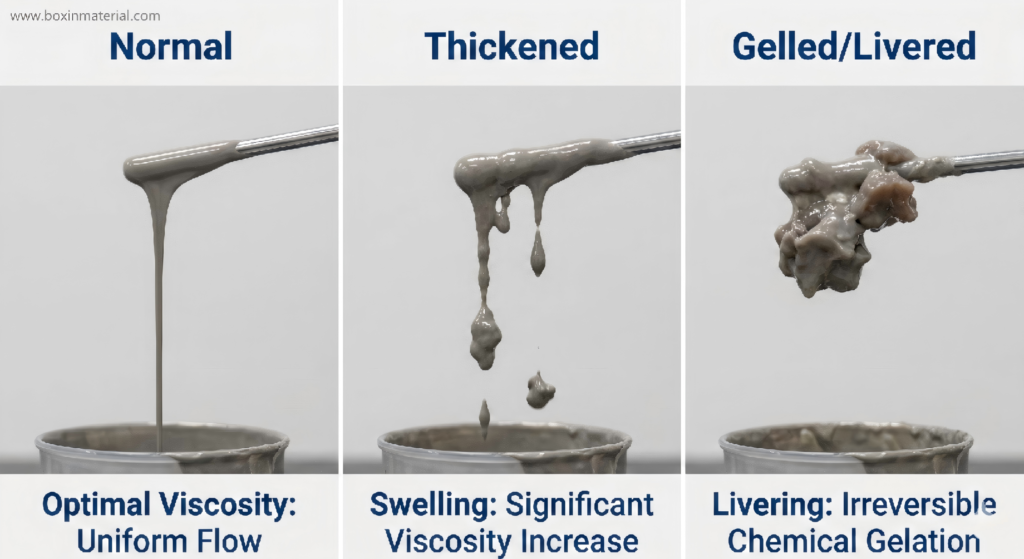
Paint thickening during storage is a critical warning sign that the chemical or physical balance of the coating has been disrupted.
In professional coatings manufacturing, the goal is to formulate a liquid containing particles that do not settle, ensuring long-term in-can stability.
When this balance fails, it often leads to a sudden viscosity increase, making the product difficult to apply or even causing it to fail the settling out of sediment standards.
Root Cause Analysis: The Science Behind Thickening
Paint thickening causes are categorized into three primary chemical mechanisms.
- Chemical Reaction Factors:
- Over-polymerization of vehicle or high acid value reacting with basic pigments
- Saponification: Acidic paints reacting with basic pigments
- Moisture Reaction: Polyurethane hardeners reacting with air moisture
- Physical Factors:
- Thinner Loss: Solvent evaporation due to poor sealing
- Water Contamination: Moisture in paint or pigments with water-soluble salts
- Temperature Effects: High temperature accelerating polymerization, low temperature causing latex paint freezing
- Time Factors:
- Overlong Storage exceeding shelf life
- Improper Thinner: e.g., asphalt paint diluted with 200# solvent gasoline
Solutions to Prevent and Fix Paint Thickening
To ensure the storage stability of coatings and maintain a liquid containing particles that do not settle, manufacturers must implement these expert strategies:
- Additive Strategy: Utilize high-efficiency dispersing agents and specialized anti-gelation agents to stabilize the pigment-binder interface.
- Quality Control: Strictly monitor the acid value of resins and moisture content of solvents before production to prevent paint thickening.
- Packaging Optimization: Use airtight seals and consider nitrogen blanketing for reactive formulations to minimize the settling out of sediment and oxidation.
FAQ: Identifying Technical Failures
It is the process where solid particles separate from the liquid phase due to gravity, often leading to a hard layer at the bottom that is difficult to re-disperse.
Maintaining proper rheology is key. By using the right concentration of rheology modifiers, you create a 3D network that keeps particles in a stable, suspended state throughout the product’s shelf life.
What We Can Offer
🏠Customized Coating Formula
🌿Raw Material Supply From China
🚀Production Technical Guidance
Serve 100+ small and medium-sized paint & ink factories!