
Microcement has revolutionized modern interior design. However, for manufacturers, the real challenge lies in the microcement formulation—balancing aesthetics with structural integrity. This guide explores the logic of professional production and the proven techniques for microcement crack prevention.
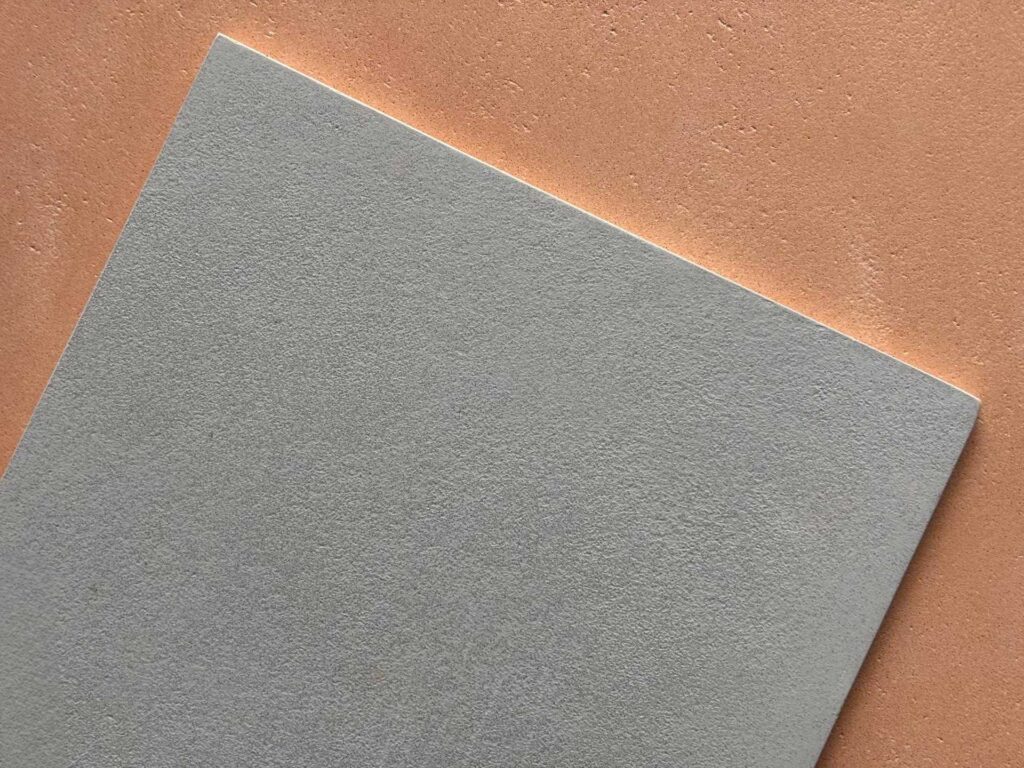
1.What is Microcement?
Microcement is a decorative thin-layer coating composed of polymer emulsions and cement-based mortar. It features excellent adhesion, flexibility, and wear resistance, making it suitable for seamless wall-to-floor finishes. Microcement was developed to overcome the shortcomings of traditional cement plasters such as cracking, efflorescence, and poor adhesion.
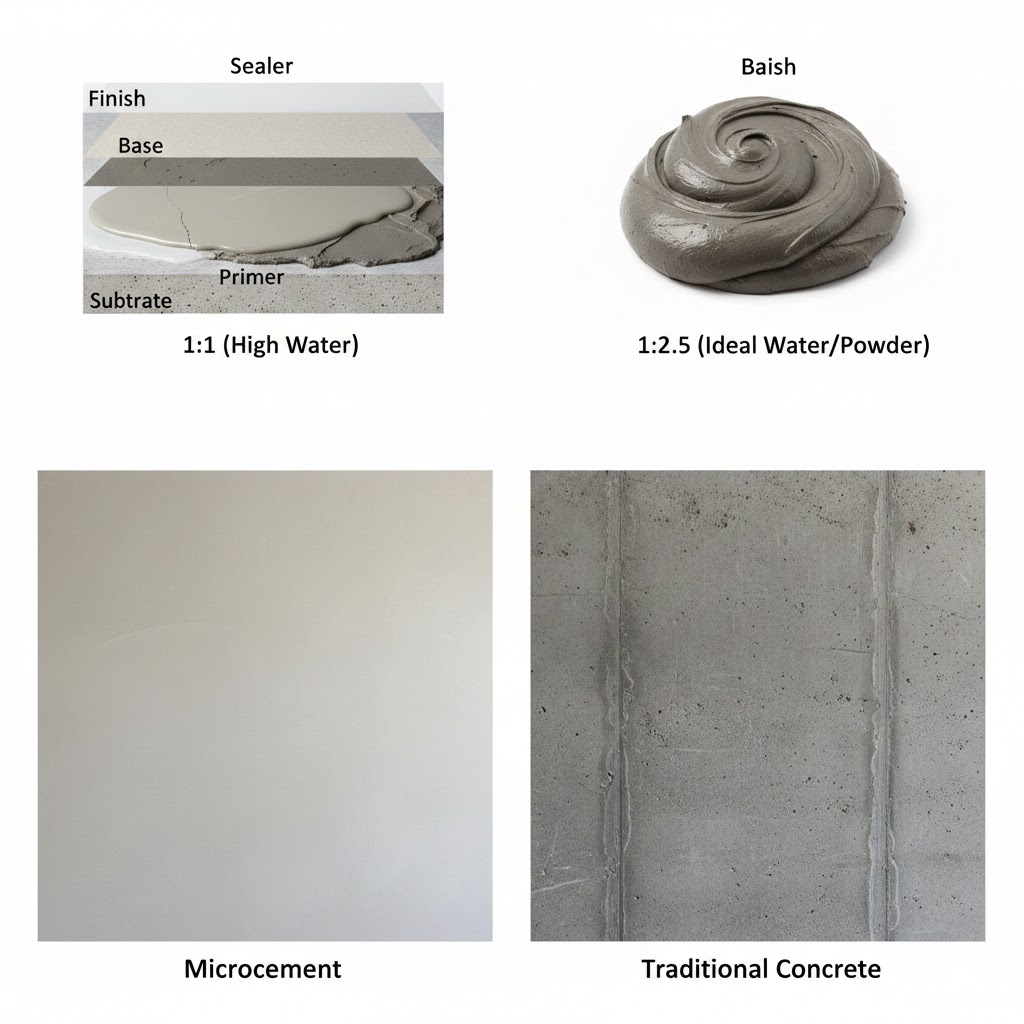
2.What Are the Layers in a Microcement Coating System?
- Primer: Improves adhesion between the substrate and the coating.
- Microcement Layer: The main decorative layer made of polymer emulsion and special cement-based powder.
- Intermediate Sealer: Prevents efflorescence and seals micro-pores.
- Top Sealer: Offers waterproofing, stain resistance, and abrasion resistance.
- In some projects, a fiberglass mesh is added to enhance crack resistance.
3. The Professional Microcement Formulation Logic
A high-quality microcement is essentially a polymer-modified cement slurry. The synergy between organic polymers and inorganic minerals determines the final performance.
- The Resin-Cement Balance: Success depends on the precise ratio of polymer emulsion (resin) to specialty cement. High resin content ensures flexibility (Adhesion), while the correct cement grade ensures hardness. We use 425/525 white cement, which can greatly increase the hardness of microcement.
- Viscosity Control: Utilizing additives like SN5040 helps stabilize the pH and ensure uniform pigment dispersion, preventing viscosity fluctuations during storage.
- Custom Design Service: If your R&D team faces technical bottlenecks, we offer customized formulation design services to match your local raw materials.
Liquid : Powder = 1 : 2.5
| Liquid Components | Content | Powder Components | Content |
|---|---|---|---|
| Water | 565 | 525 White Cement | 500 |
| Propylene Glycol | 8 | Bentonite | 15 |
| Defoamer | 2 | HPMC (100,000 Viscosity) | 3 |
| Fungicide | 1 | Wood Fiber | 4 |
| Film-Forming Agent | 8 | Sodium Gluconate | 8 |
| Emulsion | 400 | Sand (80-120 Mesh) | 470 |
| SN-5040 | 8 | – | – |
| 8D-109 | 8 | – | – |
4.Why Is “Cement Plaster + Hardener” Not True Microcement?
Some manufacturers promote “cement plaster + hardener” systems as microcement, but these lack flexibility and crack resistance. Traditional hardened floors are very hard but prone to cracking. When applied in thin layers (2–5 mm), cracks and delamination occur even faster. True microcement focuses on achieving a balance of thin-layer strength, flexibility, and adhesion.
5.Crucial Steps for Microcement Crack Prevention (Proven Techniques)
The biggest pain point for customers is cracking. We solve this through a multi-layered microcement crack prevention strategy:
Step 1: Substrate Preparation & Sealing
Clean all debris from the substrate. For tile surfaces, applying a high-performance Sealing Primer is non-negotiable to prevent delamination and air bubbles.
Step 2: Structural Reinforcement
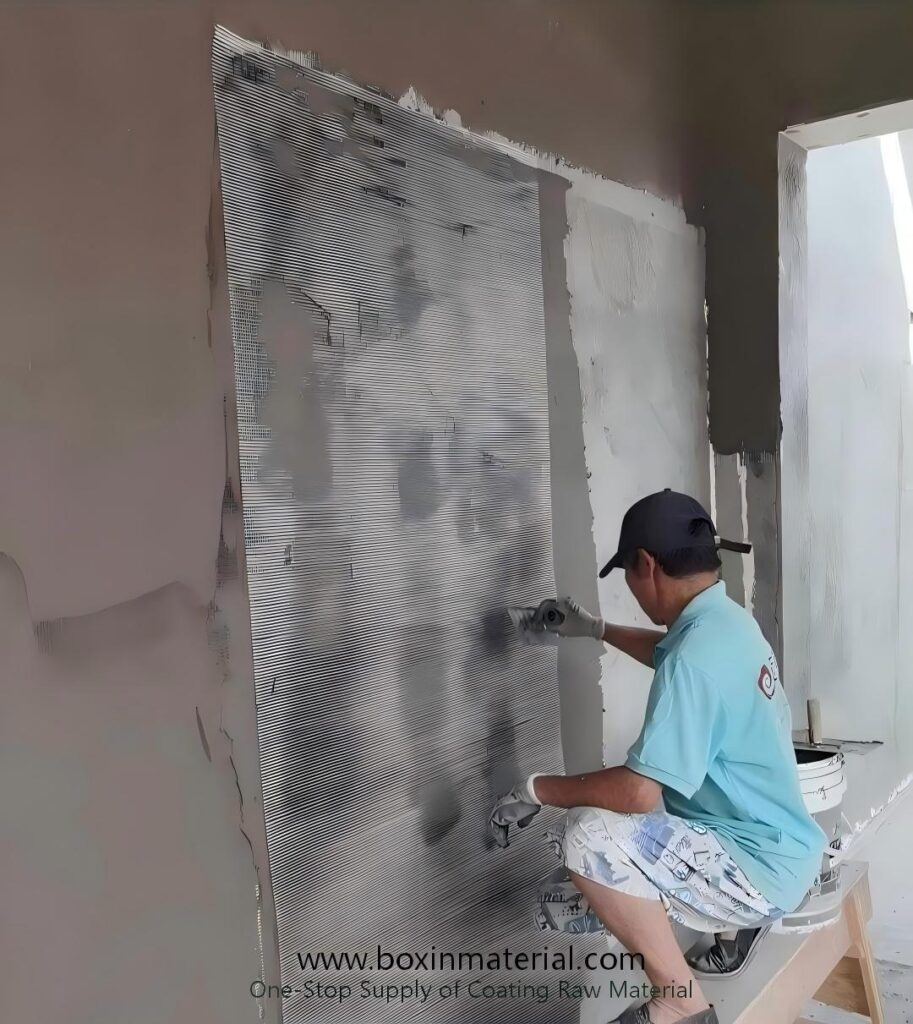
Embed an anti-crack mesh within the base coat. This mesh distributes stress across the surface, significantly reducing the risk of shrinkage cracks.
Step 3: The “Pea Stone” Strategy (Base Layer)
Our exclusive technical recommendation is to use a coarse mortar mixed with Pea Stone for the base layer.
- Why it works: Pea stone creates a physical “bone” skeleton within the coating, enhancing compressive strength and preventing deep structural cracks.
6.Why Is Microcement So Profitable for Paint Manufacturers?
- Microcement is a high-value decorative material.
- Compared with traditional latex paint, it has lower material cost but higher selling price.
- Globally, it is used in luxury homes, commercial interiors, and minimalist designs.
- The per-square-meter profit margin is typically 3–5 times higher than conventional paints.
7.One-Stop Sourcing for Microcement Raw Materials
One of the biggest hurdles for small to medium factories is sourcing multiple chemicals. We solve this through our microcement raw material supply integration.
We can consolidate all necessary components into a single container for you:
- Pea Stones & Specialty Aggregates
- Polymer Resins & Specialty Cement
- Additives (AMP-95, Defoamers, Dispersants)
This “Container Consolidation” service reduces shipping costs and eliminates the hassle of dealing with multiple suppliers.
FAQ: Frequently Asked Questions
Q: How to stop microcement from cracking? A: Effective crack prevention requires three things: 1. Proper substrate sealing with primer; 2. Using anti-crack mesh; 3. Implementing the Pea Stone strategy in the base layer to create a high-strength physical skeleton.