
Early coating failure on field erected storage tanks is typically induced by micro-condensation at the edge plates combined with localized UV-driven chalking. For assets operating in aggressive industrial atmospheres or high-salinity coastal zones, conventional painting methods offer limited defense. Securing a reliable 10 to 15-year lifecycle for tank corrosion control requires abandoning low-cost, single-coat shortcuts.
According to standard compliance frameworks like SH/T 3022-2019, GB/T 50393-2017, and ISO 8501-1, the benchmark heavy-duty solution relies on a calibrated 3-coat system: an epoxy zinc-rich primer, an epoxy mica iron intermediate coat, and an aliphatic acrylic polyurethane topcoat. This engineering matrix provides tank corrosion protection by combining sacrificial galvanic actions with physical barrier mechanics, dictating a strict total dry film thickness (DFT) of ≥ 200 μm.
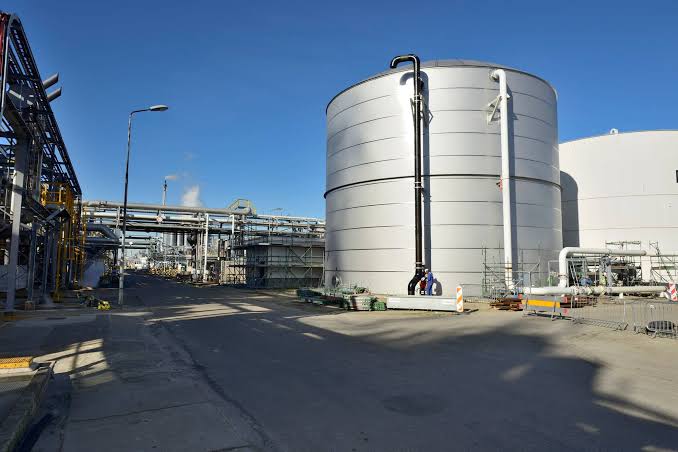
Ⅰ. Tank Coating Matrix
| Coating Layer | Coating Type | Mixing Ratio | Passes |
| Primer | Epoxy Zinc-Rich Primer | Part A : B = 9:1 | 1 |
| Intermediate | Epoxy Mica Iron Intermediate | Part A : B = 5:1 | 2 |
| Topcoat | Aliphatic Polyurethane Topcoat | Part A : B = 4:1 | 1 |
| Total | Heavy-duty System | 4 |
Ⅱ. Formulation Chemical Profiles
Long-term tank corrosion prevention cannot rely on generic coating names; it demands precision in raw material grading and mass percentages:
1.Epoxy Zinc-Rich Primer (Part A:B = 9:1) — Cathodic Protection for Storage Tanks
- E44 Epoxy Resin (16.0% by weight): Main film-former providing high mechanical strength and secure chemical bonding with the steel substrate.
- High-Purity Zinc Powder (72.0% by weight): D50-8 µm, purity >98%. Dense zinc grouping forms a continuous conductive matrix within the cured film, ensuring dry film zinc content ≥80% for true cathodic protection for storage tanks.
- Stabilizers & Solvent Array: Dispersant 110 (0.6%) and hydrophobic fumed silica (0.8%) physically eliminate agglomeration and hard settling of dense zinc during storage and application. The solvent balance of Xylene (7.0%) and n-Butanol (3.8%) controls evaporation speed to eliminate pinholes.
- Curing Agent (Part B): 100% Polyamide 650 anti-corrosion grade, reacting to yield a high cross-linking density.
2.Epoxy Mica Iron Intermediate Coat (Part A:B = 5:1) — Labyrinth Shielding
- E-20 Epoxy Resin (22.0% by weight): EEW 800-900, tailored to anchor exceptional inter-coat adhesion with both the primer and topcoat.
- Mica Iron Oxide (Scaly) (38.0% by weight): 30-60um high-purity scaly particles. Upon spray application, they orient parallel to the substrate, forcing external moisture and chloride ions through a tortuous path, creating a literal physical labyrinth barrier.
- Anti-Corrosion Enforcement: 6.0% Eco-friendly zinc phosphate and 8.0% ultrafine talc powder enhance edge-insulation and internal stress resistance against film cracking.
- Curing Agent (Part B): 100% Phenalkamine curing agent, providing low-temperature fast curing and exceptional chemical resistance.
3.Aliphatic Acrylic Polyurethane Topcoat (Part A:B = 4:1) — UV-Shielding Top Layer
- Hydroxy Acrylic Resin (42.0% by weight): OH value 90 mg KOH/g, delivering superior outdoor gloss and color retention post-cure.
- Chemical Additives (2.0% by weight): Blended with 1.2% UV Absorber UV-327 and 0.8% polyurethane-specific antioxidant. This combination captures free radicals under sunlight to protect the polymer chain against degradation, chalking, and cracking.
- Curing Agent (Part B): 100% HDI Trimer Curing Agent, a non-yellowing aliphatic grade that provides extreme surface hardness and service life under atmospheric aging.
Ⅲ. Engineering Execution: Application Process Parameters
Failure in long-term tank corrosion protection usually originates from neglecting processing windows during coating operations. Site engineering must strictly respect the following parameters:
1.Surface Prep Boundaries
- Rust Removal: Steel surfaces must undergo abrasive blasting to Sa2.5 grade, with local repair grinding to no less than St3. Surface roughness must be locked between 30-75 µm to optimize anchor profiles.
- Application Window: The first pass of epoxy zinc-rich primer must be completed within 4 hours post-blasting approval to avoid invisible flash rusting.
2.Environmental Limits
- Climatic Window: Ambient application limits span from 5°C to 35°C, with a relative humidity threshold of ≤85%.
- Dew Point Rule: Steel surface temperature must be maintained ≥3℃ above the dew point. Painting at the condensation threshold is forbidden, as microscopic water trapping will cause large-scale delamination.
3.Airless Spray Parameters
- Equipment Setup: Airless spray equipment requires a fluid pressure of 15-20 MPa and a gun distance of 20-30 cm.
- Overlap Technique: The spray pattern must achieve a 1/3 – 1/2 overlap of the spray width to ensure zero holidays or thin spots.
- Induction & Pot Life: Mixed dual-components demand an induction time (15 min for primer/topcoat; 10 min for intermediate). At 25°C, the coating holds a pot life of 4 hours; reactive remainders exceeding this window must be scrapped.
- Zinc-Rich Primer —— Mica Iron Intermediate: Wait ≥24 hours. Intermediate —— Polyurethane Topcoat: Control between ≥12 hours and ≤7 days. Exceeding 7 days dictates surface abrading to restore mechanical profiling.
Ⅳ. Rigorous Acceptance and Lab Testing Criteria
Final acceptance for storage tank corrosion containment must be established on quantitative analytics:
Acceptance & Performance Benchmarks
- DFT Verification: 90% of the field gauge points must meet or exceed the design total DFT (≥ 200um); the remaining 10% of points are allowed a minor deficit but must stay ≥ 90% of the design value.
- Adhesion Thresholds: Cross-cut adhesion must be < Grade 1; Pull-off adhesion testing requires a strict threshold of ≥ 5 MPa.
- Visual Standards: The coating must be smooth and uniform; free of visual bubbles, pinholes, sags, holidays, or peeling.
- Laboratory Verification: 1. Salt Spray Resistance: ≥1000 h in continuous salt spray testing with zero rusting, blistering, or delamination. 2. QUV Resistance: After 2000 h of aggressive QUV exposure, the topcoat must maintain a gloss retention ≥80% with zero chalking or cracking.
In a robust tank coating array, the primer relies on zinc to act as a sacrificial anode for cathodic protection for storage tanks. If the zinc load falls below 80%, the metal particles inside the dry film fail to construct a continuous conductive network, rendering galvanic defense useless. The BX-SEA-001 solution features 72.0% high-purity zinc powder by mass percentage in liquid formulation to guarantee this dry-state density.
The fan pattern of an airless spray inherently delivers a thinner film at its outer edges than in the center. Enforcing a 1/3 to 1/2 overlap ensures structural homogenization across the tank surface. Insufficient overlap creates cyclical thin spots or holidays, which act as micro-pathways for salt-spray penetration, leading to premature storage tank corrosion.
Conclusion
When optimizing lifecycle maintenance costs for field erected storage tanks, integrating strict raw material formulation with precise execution windows is the only viable path forward. Relying on the galvanic protection of zinc primers, the labyrinth barrier of mica iron intermediate coats, and the UV blocking of polyurethane topcoats—coupled with digital controls over Sa2.5 blasting, dewpoint constraints, and final DFT numbers—is the only definitive engineering strategy to ensure large industrial tank assets remain operational and rust-free for over 15 years.